
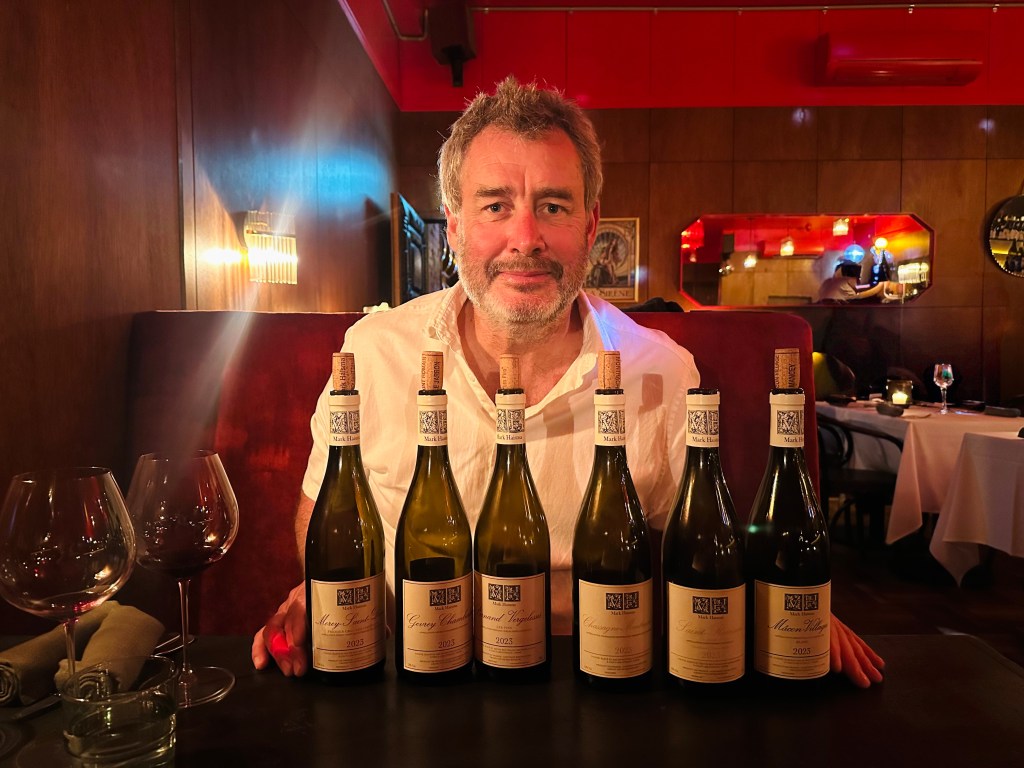
This interview appeared originally on The Wine Front
Posted on 15 November 2025 by Kasia Sobiesiak
KS: Where are you from originally?
MH: From Healesville, in the Yarra Valley. I have a French mother, a Dutch father. He immigrated as a young man to Australia. He settled in Melbourne and got pushed off into farming. He travelled back to Europe a lot. Met my mother in the Swiss Alps, and the relationship very quickly blossomed. They got married and came back to Australia. I was born in Toolangi, and then we moved to Healesville. At 18, I needed to run away, and I ran away to hospitality and then skiing all over the world.
KS: Do you remember when the wine bug bit you?
MH: Wine always was part of the family dinner. But I remember this particular job where I was in charge of the bar, and we had to go and get the bottles from the cellar. This was when I worked for a guy called Walter Bourke in Melbourne. He was an institution in Melbourne, and he had a wine bar called Walter’s Wine Bar. And it was then—on a Saturday night—I would have ten glasses lined up with Burgundy—and I just went:
Shit.
Wow.
Boom.
My mind exploded. Heightened emotions, it was just insane. So that really was that moment when I realised that I was looking at something transformational. Something impossible to grasp. Something that transcends just an alcoholic beverage. It’s more than that.
It talks of place.
It talks of emotion.
It talks about our culture.
It talks about how we eat.
It’s everything that we are.
And that was a huge moment. And then one day I just announced: I’m going to make wine.
KS: Just like that! Please tell me how it started and how you ended up at Yarra Yering.
MH: I wrote to everybody who was anybody. There was a book, the directory of Australian winemakers. I got it out, and I wrote to every single one of them. And I’ve got all their replies somewhere. I even wrote to some dead people, which was hilarious, when their children wrote back to me and said, “Thank you so much for your letter, your very interesting letter—oh, my mother’s dead—but thank you so much for your application, right at the moment we don’t have a position for you.”
(laughs)
And then I had a reply from a guy called Bailey Carrodus at Yarra Yering. He got the letter and he said, “Oh, it was interesting.” That was typical Bailey Carrodus. He was a very inquisitive man, and he questioned everything. He wanted to know everything. So he said, “Yeah, sure, you can get a job. You start at the bottom. You are just going to work in vineyards.” And that was in 1999, I’d landed at Yarra Yering. And then very quickly the relationship was built, and we formed a friendship. It turned into a ten-year apprenticeship—in the true sense of the term—the apprentice and his master, where you become an understudy. It was the grounding I needed to have, a place where I could focus my mind.
And Bailey was very strict.
Mad on focus.
And his wines were about focus.
KS: You worked there for 10 years. How did it evolve and end?
MH: By 2001, I had started to become much more involved in the winemaking. Fast forward to 2009, that was the changeover year—Paul Bridgeman joined—I was already leaving. Bailey had died in 2008. So that was the catalyst for me to think about where I was going to go. Yarra Yering was changing. And for personal reasons, I needed to go back to Europe. That was quite an emotional time leaving something as important as Yarra Yering.
KS: How did you find yourself in Burgundy?
MH: I had a friend in Burgundy whom I approached, and I said, “Look—I’d really like to start making some wine.” And he said, “Okay. That’s fine. In exchange, you help me through harvest.” And that was an amazing opportunity to be given a chance to have a space, make my wines, help him make his wines, and get exposed to Burgundy without being totally out of control, because I had that backing there. And that developed quickly. We started making the first 2009 Saint-Romain.
I wanted to make my wine.
Create my identity.
So 2009 was the first year I made wine. There are labellings of 2007 and 2008, which were pure négoce wine from finished ferments—I bought the barrels, blended, and created those first wines under my label. Then 2009, I started with Bourgogne Pinot Noir, Gevrey-Chambertin, Bonnes-Mares Grand Cru, and Clos de Bèze Grand Cru.
KS: That’s… not exactly starting small.
MH: (laughs) No—for someone just turning up in Burgundy and starting with five wines like that—that’s quite extraordinary. And it describes perfectly how different Burgundy was 15 years ago. The evolution of the micro-négoce hadn’t reached where it is now. Today, there’s a new one every day. Everyone’s trying to find a way in. So that was the beginning. And I developed a reputation very quickly, selling my wines in London to begin with. I had these contacts from Yarra Yering.
KS: Were you ever ostracised as an outsider in Burgundy?
MH: In the beginning, not so much, because I was unimportant, and hidden behind the person I worked with. But then Jancis Robinson found the wines. And went—
“Wow.”
She gave me Wine of the Week for the 2010 vintage.
And it blew up.
Boom.
I was selling wines comfortably. We were expanding. So I started to look around to build my own winery. In 2016, I bought my first piece of land, not a vineyard, just land.
KS: How does one just buy land in Burgundy? How much money do you have to have? Or who do you need to know?
MH: What we need to separate in Burgundy are vineyards and practical facilities. The value is in the vineyard. So I found a piece of land for sale where I was allowed to build a shed and make wine in it—a winery. That was 2016. 2017 was the first vintage in my own place.
Around the same time, I also came across the first piece of vineyard land in the Mâcon. It was bare land, no vines, but classified as vineyard land, and no one wanted it, because it was a bit ugly and difficult to work on. So I bought two hectares and then, of course, I had to prepare the land, plant vines, install trellising. I bought the land in 2017 and planted it in 2018.
KS: And when was the first harvest?
MH: Well, it should have been 2021. But in 2021, we had a major frost. We lost a lot. A real kick in the backside. Very upsetting. However, I wasn’t entirely devastated because, also in 2020, I bought a small domaine in Gevrey-Chambertin, about two hectares.
KS: (laughs) As one does.
MH: (laughs) Yes. I was very lucky. I knew the people who owned the domaine. I had been buying fruit from them since 2009. So we had a long relationship, and we became very good friends. One day, they said, “We are finishing”. That was a shock. And then they said, “Would you like to buy the domaine?” And that was the beginning of a massive turn in my life. So from 2016 to 2020, I went from nothing to:
a winery,
four hectares of vineyards,
a domaine in Gevrey-Chambertin.
It was huge for an Australian outsider.
KS: And yet—you weren’t ostracised.
MH: Clearly not, because the people I bought it from offered it to me. I worked at maintaining those relationships. Paying growers properly. Respecting their work. Showing up. Not being a dick. That stuff matters. You do create your own luck.
KS: Now, let’s chat about your vineyards and wines. First, tell me about your vineyard in Mâcon.
MH: In Mâcon, the vineyard is very steep, east-facing. It’s in the north of the Mâcon, so much closer to Burgundy proper—meaning cooler. I make a fresher style of Chardonnay—not the heavy, round style like some make in the lower parts of the Mâcon. My parameters are:
finesse,
character,
expression of place.
The wine is delicious—I’m not afraid of that word—delicious, juicy, friendly, something you want to drink.
KS: What’s your approach to Chardonnay then? How do you achieve the deliciousness?
MH: Chardonnay is a powerful grape. I want freshness and the natural opulence of it. I’m not interested in the reductive, super-salty, “matchstick” Chardonnay style. Those wines have no love in them. They’re difficult wines to discern place. I don’t want to hide from the power of Chardonnay. I want that power that’s balanced and precise. So I use minimal wood, often large, maybe 10–20% new. No heavy lees stirring. I don’t want winemaking tricks. I want the place.
KS: So tell me about Saint-Romain—what’s special about it?
MH: Saint-Romain is one of the first vineyards I started working with. I have such a good relationship with this grower—Nicolas Ruelle—that I put his name on the label. It’s unheard of amongst the négoce. These are very old vines. Saint-Romain is outside the big three—Meursault, Puligny-Montrachet, Chassagne-Montrachet—so it often gets overlooked. Which is insane, because the vineyards are stunning. You smell the wine—it has opulence—but then the palate snaps into freshness. That’s the contrast.
KS: You also make the Chassagne-Montrachet. What’s the approach there?
MH: For Chassagne, I don’t buy fruit—I take juice and swap it for my Gevrey-Chambertin grapes. It’s a small cuvée—five barrels—one new. Chassagne is not for today. This is a tomorrow wine. It opens slowly. It reveals itself over hours and over years. You see more tension, more line, more depth.
KS: And what about the Pernand-Vergelesses site?
MH: I’m really trying to champion Pernand because I think it’s an area of Burgundy that hasn’t had enough recognition, not enough love. Les Pins is the lieu-dit, and that comes from the very top of Pernand-Vergelesses. High—we’re at 350 meters, facing west with a pine forest behind. The vineyard is set on very deep white clay that overlays the limestone below. So all of these attributes create a very cold site—I call it a glacial Pinot Noir. Every vintage we need to wait. I’ll always pick that as the highest alcohol, generally 13–13.5%, but it doesn’t show heat. It’s an expression that I love—it’s so different to Gevrey. It has the green spectrum that I like with a little bit of spice, just to emphasise that savoury feel.
I want the sensuality, big time, involved.
And I’m a bit of an acid junkie.
I love wines that have really clear acidity. I don’t want bubble gum—I want real precision. Pinot Noir for me has to have energy, needs to have that brilliant focus. Similarly to the whites, in the reds, I don’t want to focus on wood. It’s not a thing for me. I’m very conscious not to over-extract. I’m thinking about that more lifted, aromatic feel of Pinot Noir.
KS: Finally, tell me about Morey-Saint-Denis.
MH: This is a set of three vineyards that you find above the Grands Crus on the edge of Gevrey-Chambertin and Morey-Saint-Denis. So, Latricières-Chambertin, Clos de la Roche, Clos Saint-Denis. The three Premiers Crus up on the top are Monts Luisants, Les Genavrières, and at the end Les Chaffots. They’re a really spectacular set of vineyards, all grown on roche mère—mother rock. It’s basically the bedrock that was laid down under the sea hundreds of millions of years ago and pushed up with tectonic plate movements. It’s a very thin soil. It’s a very steep vineyard, exposed to the east. We have a lot of morning sun driving the vineyards to growth.
KS: You’ve spoken a lot about freshness and balance. How does climate change fit into that picture for you? Is it getting too warm for Pinot Noir in Burgundy?
MH: Burgundy is in a revolution at the moment. Right now, there are a lot of us who are really thinking about where the next step Burgundy takes in the next 50 years. We are at a critical point right now, for Pinot Noir especially. We must understand where we’re going. This is a big conversation. There are people in Burgundy who are absolutely committed to understanding how we’re going to keep making Pinot with greatness, great elegance, beauty—all these things that we love to talk about.
Now, we’re looking at raising our canopies, clone material, rootstocks, ground cover, pruning techniques, and foliage management. There is so much thinking on how we can manage our vineyards in the right way. Changing row orientations would mean uprooting vineyards, but we discuss it. A lot is being thought about.
It’s not the end of Pinot.
How about this—we’re in a golden era for Burgundy.
Look at what we’ve been doing in the last 10 years—the consistency of the wines. We just need to be vigilant with picking times and not rest on our laurels.
KS: If Pinot is doing fine, why did you plant Syrah then?
MH: I’m a shit-stirrer, and I want to challenge. I want to ask in my hypothesis, in my experiment: can we consistently ripen Shiraz every year? That’s my question.
KS: And can you?
MH: For the moment, yes. But what’s right? Is it 13%, 14%, or is it phenolic ripeness? I’m not interested in alcohol. The grapes all come in at around 11.5–12%, and they’re phenolically ripe. You wait and wait and wait, but the grapes just won’t get more sugar, but they turn out absolutely extraordinary. So vibrantly fresh, spicy, energetic, not massively tannic. These are still very young vines—they were planted in 2019, one year after the Chardonnay.
KS: So, will Syrah replace Pinot Noir in Burgundy one day?
MH: I’m not suggesting for a minute that this is to replace anything. All I’m suggesting—that maybe it will happen in certain areas that become uncomfortable for the Pinot. Cahier des charges is so strict. It tells me what underwear I’m allowed to wear on Tuesday (laughs) So, I want to give our industry an opportunity to come and study, to come and learn, to come and see what a proper vineyard—not just a couple of rows—but 0.3 ha can produce as a small commercial batch of wine and ask that question. That’s it.
I remember once, with Bailey, after a big day, we were maybe a bit tired, and we drowned our emotions in a couple of good bottles. We decided by the end of the day, we weren’t very good at making Pinot Noir. And we left it at that. Then, I came to Burgundy, and I learnt very quickly that actually I’m irrelevant when in front of great vineyards.
The winemaker and his ego are the worst enemies to great vineyards.
So I asked myself: How do I remove myself from the equation as much as possible and allow that space, that land to express itself? I’m constantly trying to work it out. And that takes me back to those questions with Bailey, that we weren’t very good Pinot makers. We might not just have had the best Pinot site. And that is as simple as that.
Mark Haisma’s wines are imported to Australia by Ethereal Wines.
 My Wine Adviser